Driving in Montenegro — Complete Guide 2026
Driving in Montenegro — Complete Guide 2026
Why Driving in Montenegro Is Worth It
Montenegro might be small — you can drive coast to north in about five hours — but what a drive it is. This isn’t a country you want to rush through on a bus or tour. The coast road winds past hidden coves and medieval towns. The mountain routes to Durmitor cut through some of Europe’s most dramatic alpine scenery. One minute you’re by the sea, an hour later you’re in a valley watching farmers tend their goats on a hillside.
Having your own wheels means you stop when you want, sleep where you want, and discover the kind of places that tour buses never reach. Yes, Montenegro has public transport, but it’s designed for locals, not tourists with places to be. A hire car transforms your trip from a standard holiday into a genuine adventure.
Understanding Montenegro’s Roads
Montenegro’s road network isn’t extensive, but what’s there covers the essentials. The main highway (E65/E80) runs from the Serbian border in the north, through the capital Podgorica, down to the coast at Budva and Bar. It’s a good, fast road for most of the way, though things get slower and more winding as it approaches the mountains.
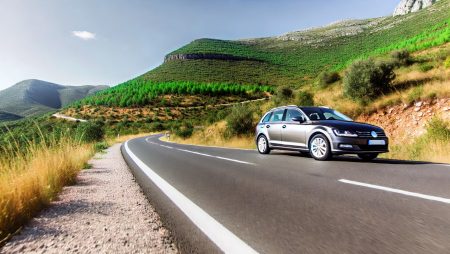
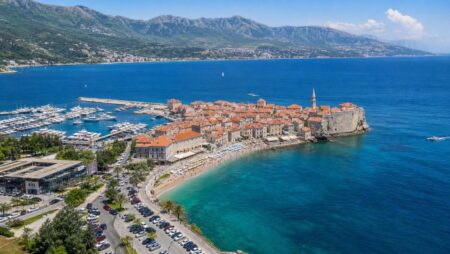
The coastal road (part of the E65) from Budva to Bar is one of the most scenic drives in Europe. It hugs the cliffs, passes through tunnels, and offers views of the Adriatic that never get old. But it’s not a motorway — expect narrow sections, curves, and the occasional slow truck to overtake.
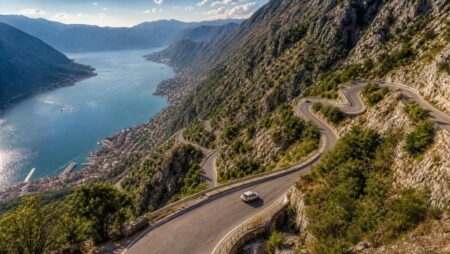
The mountain roads are where things get interesting. The road to Žabljak and Durmitor goes over the Sedlo pass at nearly 1,900 metres. The Tara Canyon road has switchbacks that would make a Swiss driver nervous. These roads are beautiful but demand respect — take your time, watch for weather changes, and don’t be afraid to stop for a photo (just not in the middle of the road).
Speed Limits and Traffic Rules
Here’s what you need to know about speed limits in Montenegro:
- Urban areas: 50 km/h
- Open roads: 80 km/h
- Highways: 130 km/h
- Temporary limits: Watch for variable speed signs, especially in tunnels and construction zones
Speed cameras are common, particularly on the coastal road and near towns. Fines are typically issued on the spot and can be steep, so don’t gamble. The police are generally visible but not aggressive — stick to the limits and you’ll be fine.
Other rules: seatbelts are mandatory for all passengers. Using a mobile phone while driving is illegal unless you have a hands-free kit. Headlights must be on at all times outside urban areas (this is a rule in many European countries, and Montenegro enforces it). Alcohol limits are stricter than in some countries — the legal blood alcohol limit is 0.03%, so stick to one drink if you’re driving, or better yet, don’t drink at all.
Toll Roads and Vignettes
Montenegro doesn’t have a vignette system like some countries. Instead, most of the main highways have toll booths where you pay based on distance. The main toll station is at Sozina, near Bar, which charges around €4-5 depending on your vehicle. You’ll also find tolls on some sections of the coastal road.
Keep some cash (euros are widely accepted) and small change for the toll booths. Credit cards are accepted at larger stations but have a backup. The toll roads are well-maintained and worth the money for the time they save.
Fuel and Petrol Stations
Fuel in Montenegro is reasonably priced compared to Western Europe. There are petrol stations throughout the country, including along most major routes. The main brands are NIS (a Serbian company), INA (Croatian), and a few others. Unleaded 95 and diesel are widely available.
In remote mountain areas (like around Durmitor or the Prokletije mountains), petrol stations can be thin on the ground. Fill up before heading into the highlands, and don’t let your tank drop below a quarter full. Many rural stations close in the evening, so plan accordingly.
Driving in Winter
Winter driving in Montenegro requires extra caution, especially in the north. The mountain roads — particularly the passes like Sedlo and the roads around Durmitor — can be snow-covered and icy from November through March. Even in spring, late snow can block high-altitude routes.
If you’re visiting during ski season (December to March), consider renting a 4WD vehicle with winter tyres. Some mountain roads may be closed or require snow chains — check conditions before you set out. The AA (Montenegrin automobile association) provides road condition updates, and local radio stations broadcast weather warnings.
Parking Tips
Parking in Montenegro varies wildly depending on where you are. In the coastal towns during summer, it can be a nightmare — streets fill up early, and illegal parking is common. Here’s what to expect:
- Coastal resorts: Paid parking zones in most towns (look for the blue lines). Around €1-2 per hour in peak season. Some hotels have private parking.
- Old towns (Kotor, Budva): Very limited parking inside the walls. Better to park outside and walk.
- Mountain areas: Usually free and easy to find, though some popular trailheads have small fees.
- Cities: Podgorica has several public car parks and some street parking.
Essential Driving Tips for Montenegro
1. Watch for animals. Goats, sheep, and cows regularly wander onto mountain roads. They’re usually accompanied by a shepherd, but not always. Slow down in rural areas.
2. Use the horn. It’s standard practice in Montenegro to honk before approaching blind corners on mountain roads — it’s a warning to any oncoming traffic.
3. Don’t trust GPS blindly. While Google Maps works reasonably well, some rural and mountain roads aren’t well-covered. Use local maps or ask locals for the more remote routes.
4. Watch for aggressive drivers. Montenegrin drivers can be impatient, especially on the coast. Don’t be pressured into speeding up.
5. Fill up early. As mentioned, fuel stations are sparse in remote areas. Don’t risk running low.
What to Carry in Your Car
Montenegrin law requires you to carry:
- Valid driving licence (your home country’s licence is usually fine for tourists, but an International Driving Permit is recommended)
- Vehicle registration documents (provided by your rental company)
- Proof of insurance (included in your rental)
- Reflective vest (must be accessible without leaving the vehicle)
- Warning triangle
- First aid kit
Most rental cars will have these items included, but it’s worth checking when you pick up your vehicle.
Border Crossings
If you’re planning to cross into neighbouring countries, Montenegro shares borders with Croatia, Bosnia and Herzegovina, Serbia, Kosovo, and Albania. Each crossing has different requirements:
- Croatia: One of the busiest crossings. EU citizens can use the automated gates; others may need passport checks.
- Albania: Generally straightforward. The main crossings are at Sukobin/Muriqan (near Ulcinj) and Vermosh (in the north).
- Bosnia and Herzegovina: Crossing at the Bay of Kotor (between Herceg Novi and Trebinje) or further north near Podgorica.
Check whether your rental agreement allows cross-border travel — many companies charge extra or restrict travel to certain countries.
Final Thoughts
Driving in Montenegro is one of the great European road trip experiences. The roads might not always be perfect, and the locals might drive with a certain… confidence, but that’s part of the adventure. Take your time, respect the mountains, and you’ll be rewarded with views and experiences that most tourists never see.
Ready to hit the road? Compare car hire prices and book your Montenegro adventure today.