Driving a Rental Car in Montenegro: Local Rules, Road Conditions and What to Watch For
What It Is Really Like Behind the Wheel in Montenegro
Driving a rental car in Montenegro is one of the best ways to see the country — and one of the most demanding. The views are extraordinary, the roads are narrow, and the locals drive like they are late for a wedding. If you are coming from western Europe, the experience can feel a little wild at first. But once you understand the rhythm of the road, the pay-off is enormous: hidden beaches, mountain villages and viewpoints that no bus route will ever reach.
This guide covers the practical stuff — the rules that matter, the road conditions that catch people out, and the local habits worth knowing before you turn the key.
The Basics: Licence, Age and Insurance
You need a valid driving licence from your home country and an International Driving Permit (IDP) if your licence is not in the Latin alphabet. Most rental desks in Montenegro will not enforce the IDP requirement, but if you are stopped by police, they can — and the fine is on you.
Minimum rental age is usually 21, with at least one year of driving experience. Some suppliers charge a young-driver surcharge for under-25s. Full insurance with zero excess is strongly recommended: Montenegrin roads put more dents in cars than most European destinations.
For a full breakdown of booking and insurance specifics, see our guide to hiring a car in Montenegro for first-timers.
Road Conditions: What to Expect on Each Route Type
Coastal Roads (Jadranska Magistrala)
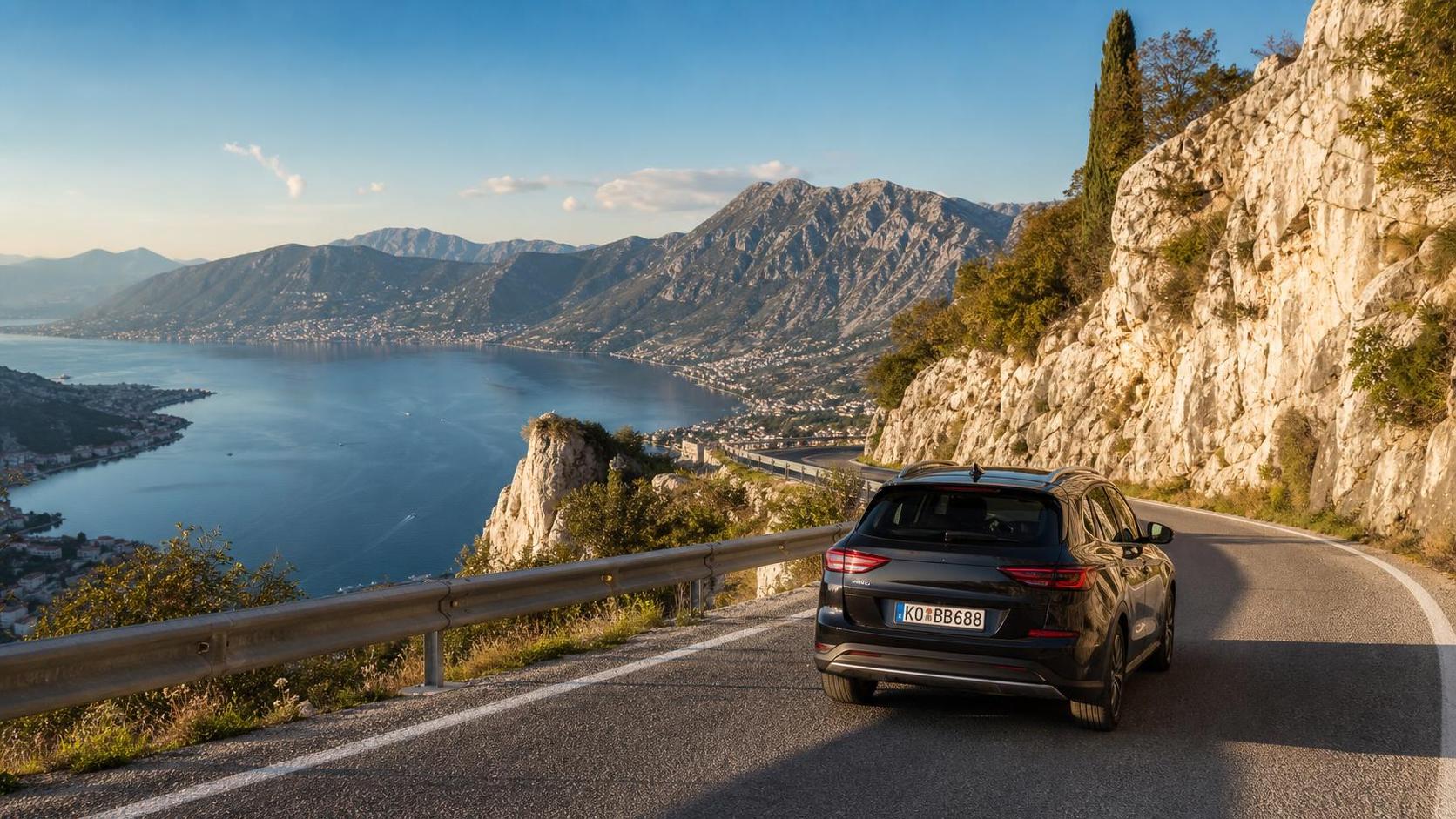
The Adriatic coastal road is the main artery linking Kotor, Budva, Bar and Ulcinj. It is scenic, well-paved and generally in decent condition — but it is also narrow, winding and busy in July and August. Key things to know:
- Many stretches have no hard shoulder — the rock face is on one side, a drop to the sea on the other
- Overtaking is limited; locals will tailgate and then overtake on blind bends
- Pull-outs for photos are few and often taken by buses
- Parking in coastal towns is tight — read our Kotor parking guide and Budva parking guide before you go
Mountain Roads (Interior and Northern Montenegro)
Roads heading inland from the coast — the serpentine climb from Kotor up to Cetinje, the route to Žabljak, and the Kolašin passes — are a different beast. These are the roads where a rental car really earns its keep, but also where conditions demand the most care:
- The Kotor serpentine has 25+ hairpin bends on a single-lane road with rock walls — go slow, use your horn on blind bends
- Road surfaces can be patchy: new tarmac one moment, potholes and gravel the next
- Fog rolls in fast at altitude, especially mornings near Kolašin and Lovćen
- From November to March, snow chains are mandatory on mountain roads and some passes close entirely — our seasonal car hire guide has month-by-month details
City Driving (Podgorica and Coastal Towns)
Podgorica is the only city in Montenegro with anything resembling multi-lane roads. Elsewhere, urban driving means one-lane streets, parked cars narrowing the road further, and pedestrians who step out without looking. Roundabouts exist but are treated as suggestions by some drivers. Indicators are optional, apparently.
Local Driving Habits You Need to Know
Montenegrin driving culture is informal. Here is what actually happens on the road:
- Flashing headlights means “I am coming through, get out of the way” — the opposite of letting you go first
- Left indicator on at a roundabout might mean they are exiting — or might mean nothing at all
- Overtaking on bends is common among locals. Do not join in, and do not panic — just hold your line
- Double-parking is normal in Budva and Kotor Old Town. Expect to manoeuvre around cars stopped in the lane
- Speed limits: 50 km/h in towns, 80 km/h on open roads, 100–130 km/h on the few dual carriageways. Enforcement is light outside cities, but speed cameras exist near Podgorica and on the coast
For the legal detail, see our Montenegro driving laws guide for tourists.
Petrol, Tolls and Practical Costs
Petrol stations are plentiful on the coast and along main roads but sparse in the mountains. Fill up before heading inland from Kotor or Budva. As of 2026, fuel costs roughly €1.55–1.65 per litre.
There is one toll road in Montenegro: the Sozina Tunnel between the Kotor Bay area and Bar, costing €2.50 for cars. It saves 30 minutes and is well worth it. No other tolls exist.
Parking in most towns costs €0.50–1.50 per hour. Paid zones use SMS-based systems (text your plate number to the code on the sign) or parking machines that rarely accept cards — carry €1 and €2 coins.
Rental Car Specifics: What Can Go Wrong
A few things catch out rental car drivers in Montenegro more than anywhere else:
- Underbody damage: Mountain roads have deep potholes and unpaved sections. Take it slow — a cracked sump will cost you your excess
- Windscreen chips: Gravel on mountain roads means stone chips are common. Full insurance is worth it here
- Key locking: Some coastal rental offices give you a physical key with no spare. Lock it in the car and you are calling a locksmith in a town where nobody speaks English
- Cross-border restrictions: Most rental agreements prohibit driving into Kosovo. Albania and Bosnia are sometimes allowed for an extra fee — always check before you book. Our cross-border travel guide has the details
Routes Worth Driving (and Where to Be Careful)
The Kotor Serpentine to Lovćen
Twenty-five hairpin bends climbing 1,000 metres above the Bay of Kotor. Start early (before 8am) to avoid tourist buses and midday heat. The viewpoint at the top is one of the best in Europe. See the full route in our Lovćen National Park driving guide.
Podgorica to Žabljak via the Tara Canyon
A stunning drive through the mountains to Žabljak and the Durmitor National Park. Road quality is decent on the main route (E65/E762) but deteriorates on side roads. Allow 2.5 hours, more in winter.
Coastal Road: Herceg Novi to Ulcinj
The full length of the coast in one drive — about 3 hours without stops, but you will want to stop. Herceg Novi through Budva, Bar and down to Ulcinj. Busy in summer, narrow in places, and the views justify every kilometre.
Checklist Before You Drive Off the Lot
- Photograph all existing damage — every scratch, dent and wheel scuff — before you leave the car park
- Check that the spare tyre, jack and warning triangle are present (legally required)
- Confirm the fuel policy (full-to-full is standard and cheapest)
- Get a phone number for the rental office — you will need it if the car breaks down in the mountains
- Download offline maps (Google Maps or Maps.me) — mobile signal drops in the interior
- Verify cross-border permission if you plan to visit Albania, Bosnia or Croatia
The Bottom Line
Driving a rental car in Montenegro is not difficult — it is just different. The roads are narrower, the local style is more assertive, and the mountain routes demand attention. But the freedom to pull over at a viewpoint above the Bay of Kotor, to detour to a village bakery in the interior, or to reach a beach that no tour bus can access — that is worth every hairpin bend.
Compare trusted suppliers and lock in a competitive rate for your Montenegro trip. No hidden fees, free cancellation, and cars you can take cross-border (with permission).
Related Destinations
Looking for car hire nearby? Also explore Kotor, Tivat Airport, Podgorica and Herceg Novi.
Ready to book? Visit our homepage for the best hire car deals.