Renting a Car in Montenegro with a Family: Child Seats, SUVs and Practical Tips
Travelling through Montenegro with children adds a few extra considerations to your car hire plans. The country is compact, scenic and largely safe for family road trips, but the coastal roads, mountain passes and summer heat all bring practical questions that are worth sorting out before you arrive at the rental desk. This guide covers what families actually need to know about hiring a car in Montenegro, from child seat rules and vehicle choice to routes that work well with younger passengers.
Why a Rental Car Makes Sense for Families in Montenegro
Public transport in Montenegro is limited outside the main coastal strip. Buses run regularly between Podgorica, Budva, Kotor and Bar, but getting to beaches, national parks and inland towns with children, luggage and pushchairs is genuinely awkward without your own vehicle. A rental car gives you the flexibility to stop when someone needs a break, detour to a quieter beach, or cut a day short if the heat becomes too much. Most families find that the convenience outweighs the cost, especially when split across four or five people.
Child Seat and Booster Requirements
Montenegrin traffic law follows EU guidelines on child restraints. Children under 150 cm in height or 36 kg in weight must use an approved child seat or booster appropriate for their size. The rules are enforced at police checkpoints, particularly during the summer season.
When booking your rental car, request child seats in advance. Most rental desks in Podgorica and Tivat airports stock them, but quantities are limited in peak season (July and August). Specify your child’s age and weight when reserving so the desk can prepare the correct seat type. Expect to pay around €5–8 per day for a child or booster seat. Some local operators include one free of charge on longer rentals, but this is not standard across the market.
If you are bringing your own seat, it is worth checking whether your airline allows it as checked baggage. Montenegrin rental desks will not fit a seat for you unless you have booked it through them, so a privately owned seat must be installed by the parent.
Choosing the Right Vehicle
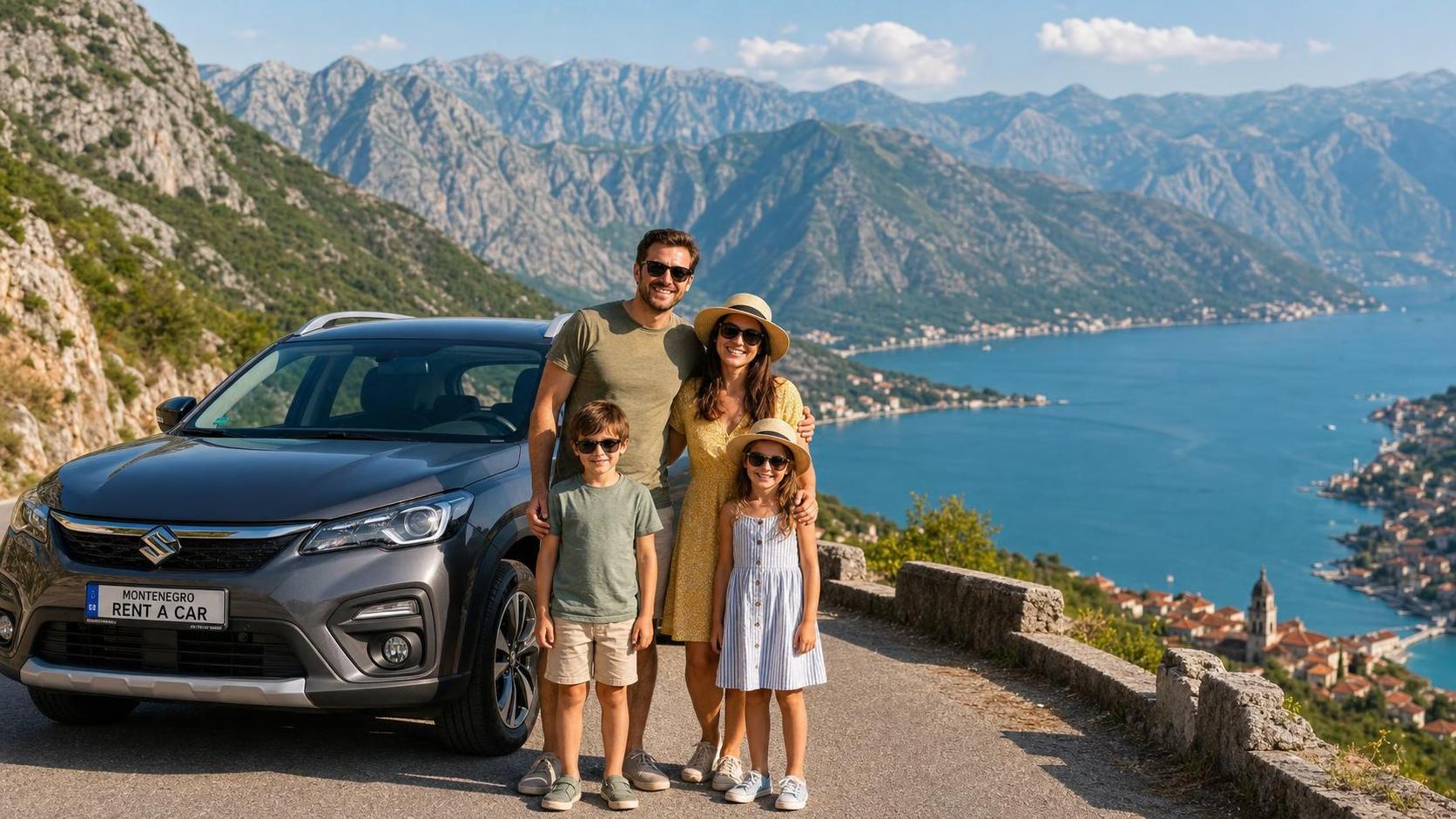
For a family of four with moderate luggage, a compact SUV or mid-size estate is the most practical choice. Roads in Montenegro are generally good along the coast, but mountain routes such as the Kotor serpentine and the road to Žabljak are narrow, steep and occasionally rough at the edges. A vehicle with slightly higher ground clearance and air conditioning is not a luxury here; it is a practical requirement.
Avoid very small city cars if you are planning to visit Durmitor National Park or the Lovćen mountain road. The 25 hairpin bends above Kotor are dramatic and safe in a capable car, but a tiny hatchback with underpowered engine and basic suspension will make the journey uncomfortable for everyone. Similarly, the route from Kotor to Žabljak via Nikšić involves sustained climbs and descents where engine braking matters.
For families with three or more children, a seven-seater is available in Montenegro but must be reserved well in advance. The fleet of larger vehicles is smaller than in Western European markets, and popular models are often committed weeks ahead in summer.
Practical Driving Tips with Children
The Montenegrin coast gets very hot in July and August. Plan longer drives for the early morning or late afternoon. The midday sun on the Bay of Kotor road, in particular, can make an unairconditioned car genuinely unpleasant. Carry water, snacks and sun cream in the vehicle. Petrol stations are frequent along the coastal highway but thin out inland; fill up before heading to Durmitor, Biogradska Gora or the Prokletije region.
Toll roads are minimal in Montenegro. The Sozina Tunnel between Budva and Bar costs around €2.50 each way. There are no other significant tolls, so budgeting is straightforward. Fuel prices sit at roughly €1.55–1.65 per litre for petrol and €1.60–1.70 for diesel, slightly below the EU average.
Parking in Kotor Old Town and Budva can be challenging in summer. The public car parks near Kotor’s city walls fill by mid-morning. If you are visiting with children, arrive before 09:00 or use the parking areas just outside the walled centre and walk in. In Budva, the paid zones near the marina are your best option for a family day at the beach, though rates rise in peak season. Our parking in Kotor Old Town guide and Budva parking guide cover costs and locations in detail.
Family-Friendly Routes and Stops
Some drives in Montenegro suit families better than others. The coastal road from Herceg Novi to Kotor is relatively gentle, with excellent views and plenty of places to stop for photographs or ice cream. The Bay of Kotor itself is calm, warm and shallow in many places, making it ideal for younger swimmers. Older children usually enjoy the dramatic scenery on the road from Kotor to Žabljak and Durmitor National Park, though the narrow mountain sections require an attentive driver.
Lake Skadar, roughly 30 minutes south of Podgorica, is an excellent half-day trip. The water is warm, flat and safe for paddling, and boat trips from Virpazar village are popular with families. The Podgorica to Lake Skadar route is an easy drive on good roads.
If you are staying in Budva, the beaches at Jaz and Slovenska Plaža are wide, sandy and well-equipped with cafés and changing facilities. Both are accessible by car with nearby parking. For a quieter family beach day, drive south to Petrovac or Sveti Stefan, where the water is calmer and the crowds thinner than in central Budva.
What to Pack for a Family Road Trip
Beyond the usual travel essentials, a few items are particularly useful in Montenegro. A portable phone charger or dual USB adapter keeps devices alive during longer drives; offline maps are essential because mobile signal drops in mountain areas. A small cooler bag for drinks and snacks saves repeated café stops, which add up quickly with children. If you are visiting in spring or autumn, pack layers; coastal and inland temperatures can differ by ten degrees or more.
It is also worth downloading the parking payment app used in coastal towns. Many zones use SMS or app-based payment, and the instructions are usually in Montenegrin only. Your rental company or hotel reception can walk you through it.
Insurance and Excess: What Families Should Know
Standard rental insurance in Montenegro typically includes third-party cover and collision damage waiver (CDW) with an excess of around €500–1,500. For family travel, where scrapes from narrow parking or tight village streets are more likely, consider reducing the excess to zero or taking Super CDW. The additional daily cost is usually €8–15 but removes the stress of a potential claim if a child accidentally opens a door into a wall or a parking barrier.
Check whether your travel insurance or credit card includes rental car excess cover before purchasing additional products at the desk. Many UK and EU policies do, but you will still need to leave the deposit on your credit card when collecting the car.
Booking Your Family Rental Car
The best approach is to book early, specify child seats and vehicle choice clearly, and confirm directly with the rental office a few days before arrival. Tivat Airport is closest to the coast and Kotor; Podgorica Airport is more convenient if your accommodation is inland or you are planning to visit Lake Skadar and the northern mountains first.
Most desks require the driver to be at least 21 years old with two years’ held licence. An International Driving Permit is recommended alongside your national licence, though many UK and EU renters report smooth collection with just the photocard.
Compare Family Car Hire in Montenegro
Use the search above to compare prices across Podgorica, Tivat, Kotor and other locations. Filter by vehicle size, check child seat availability, and book in advance to secure the best rates for your family holiday.
Ready to book? Visit our homepage for the best hire car deals.