One Week in Montenegro by Car: The Ultimate Road Trip Itinerary
Montenegro packs an extraordinary range of landscapes into a country smaller than Wales. In a single week you can drive from fortified coastal towns to glacial lakes, cross dramatic mountain passes and eat fresh seafood metres from the water. The distances are short, the roads are surprisingly good, and a rental car is the only way to see it properly on your own schedule.
This itinerary assumes a 7-day trip with pickup at either Tivat Airport or Podgorica Airport. Tivat is closer to the coast; Podgorica is better if you want to start inland. Both have rental desks and similar opening hours, roughly 08:00 to 22:00 in summer, shorter in winter.
Day 1: Arrival and Kotor Old Town
Collect your car and head straight to Kotor. From Tivat Airport this is a 15-minute drive on the E65. From Podgorica, allow 1 hour 30 minutes via the M2.3 motorway and the Vrmac Tunnel toll road.
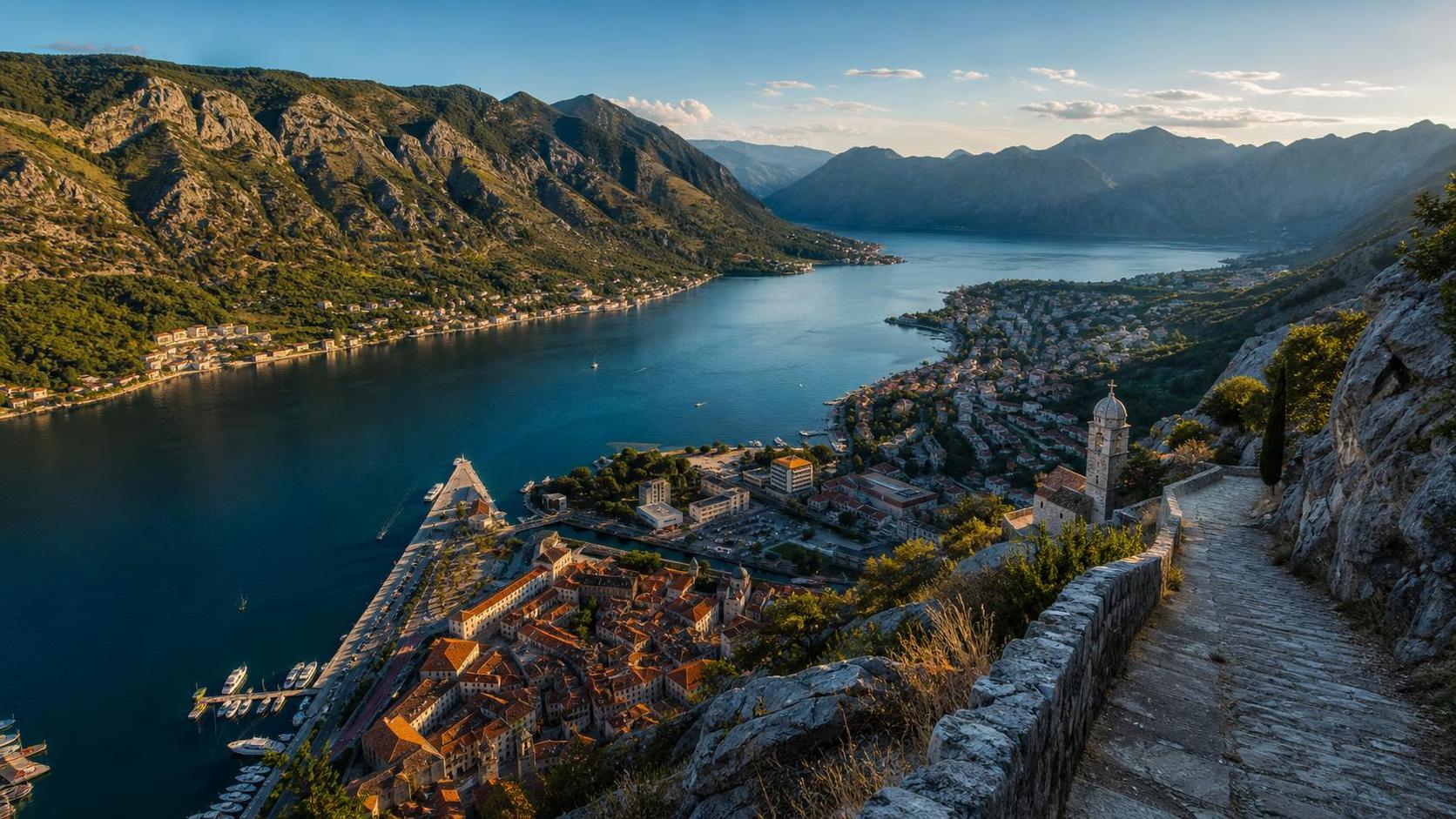
Kotor’s Old Town is a UNESCO-listed maze of stone alleys, small squares and Renaissance churches. The town sits inside a natural fjord, with mountains rising straight from the water. Park at the North Gate car park just outside the walls (about €1–2 per hour in season) or at the larger lot near the bus station for longer stays. Parking in Kotor fills fast in July and August, so arrive early.
In the evening, walk the 1,350 steps to the fortress above the town for sunset. The view over the Bay of Kotor is the reason most people come here.
- Driving distance: Tivat Airport to Kotor — 8 km, ~15 min
- Where to stay: Inside the walls for atmosphere, Dobrota just outside for quieter waterfront hotels
Day 2: The Bay of Kotor and Perast
Drive the coastal road north from Kotor to Perast, a small Baroque village 15 minutes away. The road hugs the water, passing yachts and stone waterfront houses. In Perast, park at the northern end of the village and walk to the stone pier for boat trips to Our Lady of the Rocks, a small church built on an artificial island in the bay. The boat ride takes 20 minutes and costs around €5 per person.
After lunch, continue north to the Verige Strait, the narrowest point of the bay, then loop back through Risan. If you want a longer afternoon, drive the Lovćen serpentine from Kotor up to Njegoš Mausoleum. The road has 25 hairpin bends and climbs to 1,300 metres. Take it slowly — the drops are sheer and there are no guardrails in places. The views from the top stretch across half of Montenegro on a clear day.
- Driving distance: Kotor ↔ Perast — 12 km each way; Kotor → Lovćen → Kotor — 45 km loop
- Tip: Compact car is fine for the serpentine; you want something nimble for the tight switchbacks
Day 3: Kotor to Budva and the Coast
Drive from Kotor to Budva in the morning. The direct route on the E65/E80 takes 25 minutes, but the coastal road via Sveti Stefan is more scenic. Sveti Stefan itself is a private island-hotel now, but you can photograph it from the viewpoint on the mainland.
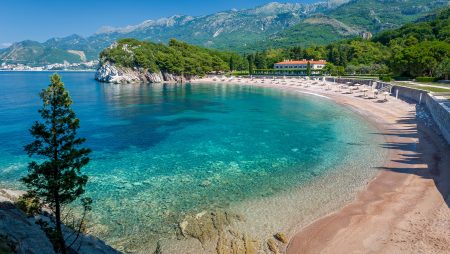
Budva is Montenegro’s busiest resort town. The Old Town is smaller than Kotor’s but still worth an hour of wandering. For beaches, Mogren is the best within walking distance of the walls. For something quieter, drive 10 minutes south to Jaz Beach or Pržno. Parking in Budva is cheaper than Kotor — about €0.50–1 per hour at metered zones near the Old Town.
Spend the night in Budva if you prefer nightlife, or drive 15 minutes inland to Cetinje, the old royal capital, for a quieter evening and cheaper accommodation.
- Driving distance: Kotor → Budva — 22 km, ~25 min
Day 4: Cetinje, Lovćen and the Mountains
Leave the coast and drive inland to Cetinje. The road climbs steadily through olive groves and then forest. Cetinje sits at 670 metres and has a different character from the coast — more formal, with 19th-century embassies, the royal palace and the Orthodox monastery where Montenegro’s most important relics are kept.
From Cetinje, take the old road up to Lovćen National Park. This is the back side of the serpentine you saw on Day 2. The road surface is good but narrow; you will meet tourist buses and locals driving faster than you. The Njegoš Mausoleum sits at the summit — 461 steps from the car park to the top, where a huge granite statue looks out over the country.
Continue over the mountain and descend towards Podgorica. The landscape opens into wide valleys and vineyards. Stay overnight in Podgorica or push on to Žabljak if you want to be closer to Durmitor for Day 5. The Podgorica to Žabljak drive takes about 2 hours 30 minutes on the M2 and M3.
- Driving distance: Budva → Cetinje — 32 km; Cetinje → Lovćen summit — 20 km; Lovćen → Podgorica — 55 km; Podgorica → Žabljak — 135 km
- Tip: Fill up before Cetinje. There are no petrol stations on the mountain road
Day 5: Durmitor National Park
Žabljak is the base for Durmitor National Park, a UNESCO-listed area of glacial lakes, dense pine forest and 48 peaks over 2,000 metres. The Black Lake (Crno Jezero) is a 10-minute walk from the town centre and the easiest introduction to the park.
For a proper hike, drive to the trailhead for Bobotov Kuk, Durmitor’s highest peak at 2,522 metres. The return hike takes 6 to 8 hours and requires reasonable fitness. For something shorter, the Tara River Canyon viewpoint near Đurđevića Tara Bridge is a 30-minute drive from Žabljak and needs no walking.
The Durmitor road trip from Žabljak to Plužine and back makes a good half-day driving loop if you want to see the canyon from multiple angles.
- Driving distance: Žabljak → Tara Canyon viewpoint — 25 km; Žabljak → Plužine — 50 km
- Tip: Bring layers. Even in July, morning temperatures at 1,500 metres can be below 10 °C
Day 6: Lake Skadar and the South
Drive south from Žabljak or Podgorica towards Lake Skadar, the largest lake in Southern Europe. The Virpazar village on the northern shore is the traditional starting point for boat trips. The road from Podgorica to Virpazar is flat and fast; from Žabljak, it is a longer, winding descent through the mountains.
Boat trips from Virpazar last 2 to 4 hours and pass through narrow channels between water lilies, past fishing villages and ruined monasteries. The lake is a Ramsar wetland and one of Europe’s most important bird habitats — pelicans, herons and cormorants are common.
After the lake, continue to Ulcinj on the coast. The town has a distinct feel — more Mediterranean than Montenegrin, with a large Albanian population, minarets and a sandy beach that stretches for 12 kilometres. The Old Town sits on a rocky outcrop above the beach and is worth a walk before sunset.
- Driving distance: Žabljak → Virpazar — 110 km; Virpazar → Ulcinj — 60 km
- Tip: Ulcinj has some of the cheapest seafood restaurants on the coast. Eat early — many close by 22:00
Day 7: Return and Departure
From Ulcinj, drive back to your departure airport. To Tivat, the coastal route via Bar and Budva takes about 1 hour 45 minutes. To Podgorica, the inland route via the M2 motorway takes about 1 hour 15 minutes. Both are straightforward drives with good road surfaces.
If your flight is in the evening, stop at Bar for lunch at the waterfront. The town itself is modern and unremarkable, but the Old Olive Tree of Mirovica — claimed to be over 2,000 years old — is a 10-minute drive from the centre and makes an odd but memorable final stop.
- Driving distance: Ulcinj → Tivat Airport — 95 km, ~1h 45min; Ulcinj → Podgorica Airport — 75 km, ~1h 15min
Practical Notes for the Whole Week
Fuel: Petrol stations are common on the coast and main roads. Inland and in Durmitor, fill up whenever you pass a station. Prices run roughly €1.55–1.70 per litre (prices change; verify locally).
Tolls: The Sozina Tunnel near Bar costs €2.50. The Vrmac Tunnel near Tivat costs around €2.50. All other roads in this itinerary are toll-free.
Mountain roads: The Lovćen serpentine and the Durmitor passes are safe in dry weather but can be foggy above 1,000 metres from October to April. Snow chains are a legal requirement in winter on mountain roads. Check local conditions before travelling.
Cross-border: If you want to extend the trip into Albania or Croatia, read our cross-border rental car guide first. Not all suppliers allow it, and Albanian insurance usually requires an add-on.
Driving style: Montenegrin drivers overtake on bends, ignore indicators and park wherever there is space. Stay alert, give way to faster traffic and do not expect locals to follow the same rules you are used to. See our full driving in Montenegro guide for more detail.
What Car Do You Need?
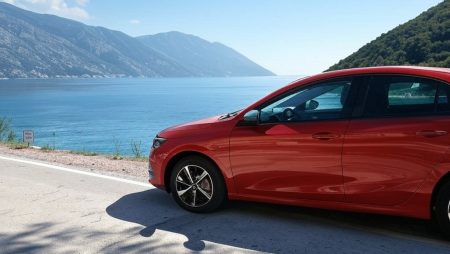
A compact car is sufficient for the coast and most inland routes. If you are travelling in a group of four with luggage, a mid-size estate gives more boot space. For Durmitor and the mountain roads, a car with decent clearance is helpful but not essential — the main roads are paved. Air conditioning is non-negotiable in July and August when coastal temperatures reach 35 °C.
Automatic transmission is worth the extra cost if you are not comfortable with manual on steep hills. Most suppliers at Tivat and Podgorica airports stock both.
Compare Car Hire for Your Montenegro Road Trip
Start your trip with the right vehicle. Compare rates at Tivat Airport or Podgorica Airport and pick up a car that matches your route.
Ready to book? Visit our homepage for the best hire car deals.